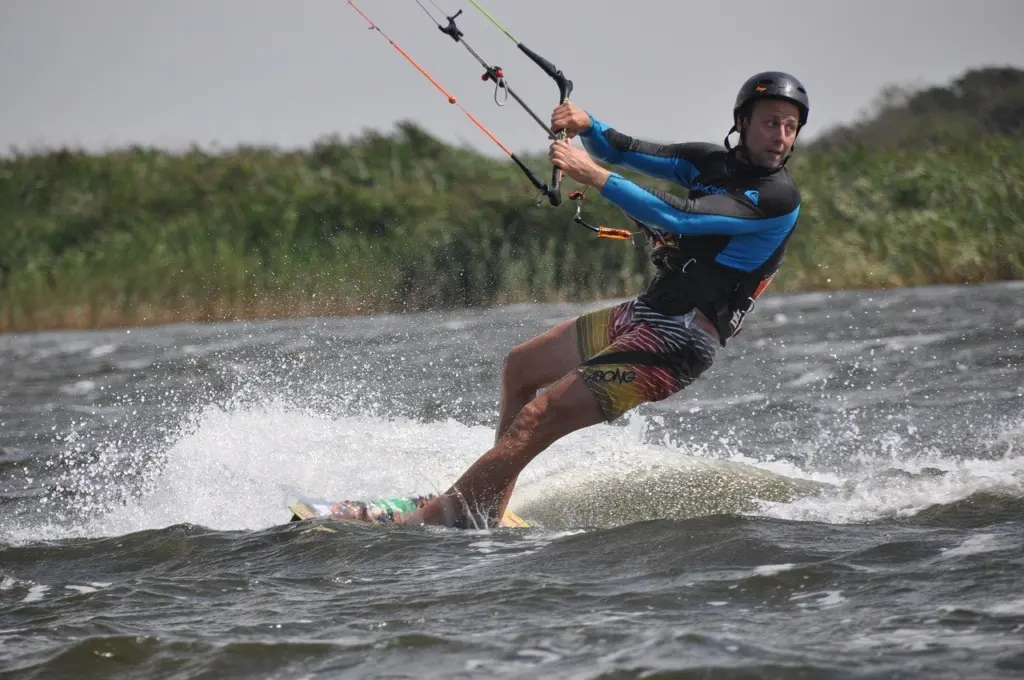
A kitesurfing helmet is a water-specific helmet with an adjustable chin strap and draining ear protection, worn against impact injuries. Pair it with a vest approved for flotation, not just padded, whenever help is far away.
Picture a launch beside a rocky shoreline, or a remote session where a rescue boat would take a long time to arrive. Those are the moments this guide is built around. If you are still putting a kit together, start with kitesurfing gear for beginners, then return here to choose head and torso protection.
Deciding whether a helmet is worth wearing
Yes, a helmet is worth wearing whenever a hard impact is plausible. Water helmets are designed to protect surfers, kiteboarders and other water-sports users from head injuries caused by impact. That is the whole job of the product, and it is a narrow one. A helmet will not keep you afloat, warm or visible, so it works alongside other kit rather than replacing it.
The decision is personal, and it gets easier when you stop asking whether you will fall and start asking what you could hit.
Water, board and shoreline impacts
There are three things a rider can strike: the water, the board and the shoreline. Water impacts are the most common. A helmet adds a layer between your head and the surface when you are pulled off line or land badly. The board is a hard, moving object that can end up close to your head in a crash, which is one more reason to protect the head rather than only the body.
Hard shoreline is a different case. Rocks, concrete, sea walls and packed shingle do not give way, so launching and landing there is where padding earns its place. If your usual spot is soft sand with deep water beyond it, the shoreline argument weakens, but the water and board arguments remain.
Choosing a helmet that works in water
Choose a helmet built for water, with a secure chin strap, a way for water to leave the ear area and, ideally, a foam liner. The best kitesurf helmet for you is the one that meets those three conditions and sits comfortably enough that you never feel tempted to leave it on the beach.
Ear drainage and ventilation
Water helmets commonly feature adjustable chin straps, ventilation systems and water-draining ear protection. Ear drainage matters because you will spend time in and under the water. A shell that traps water around the ears is uncomfortable and heavy. Check that the ear sections have visible openings or are designed to let water out, and that they do not seal over your ears in a way that blocks sound entirely.
Foam liners and foam density
Some models also include shock-absorbing foam liners for added safety. Foam density is the property that governs how a liner absorbs a blow, but product listings rarely reduce it to a single comparable figure. In practice, prefer a helmet that states a shock-absorbing liner over one that states none, and compare models on how clearly the manufacturer describes the lining. Where two helmets are otherwise close, the one that tells you more about its liner is the safer bet.
Getting the fit and chin strap right
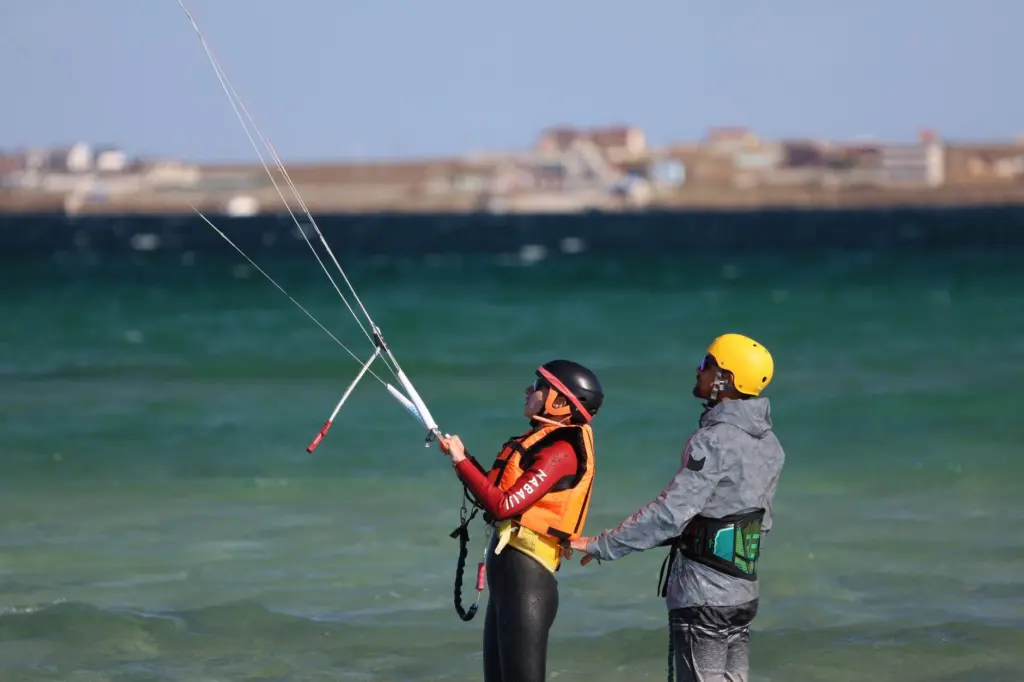
A helmet only protects if it stays where it is meant to sit. Pick the size on the label that matches your head, then adjust the chin strap until the helmet holds steady when you shake your head, without pressing on your throat. Listings for popular models show a range of sizes, so a loose helmet usually means the wrong size, not a strap problem.
Adjust the strap while wearing the wetsuit hood or whatever you will actually ride in, since added layers change the fit. Re-check it after your first fall of the day, because water and movement can loosen buckles. The helmet should sit level on your head, not tipped back on your crown or pulled down over your brow.
Can a wakeboard or sailing helmet do the job?
Often yes, if it has the same water features as a kitesurfing helmet: a secure adjustable chin strap and ear protection that lets water out. Wakeboard and sailing helmets are designed for the same wet environment, so the useful test is the feature list, not the sport printed on the box.
One rider on a kitesurfing forum describes a Protec Ace Wake costing about £50, with removable ear guards that make it good for getting water out, and uses it for both water and snow. That is one rider’s report, not a test, but it shows the logic: removable ear guards let one helmet cover cold-weather and water use. A ski helmet with fixed, closed ear padding would not meet the drainage requirement.
Impact vest or buoyancy vest
An impact vest is padding for the torso, built with foam panels to cushion a hit. A buoyancy vest is flotation. They answer different problems, and a vest that does one does not automatically do the other. Safety guidance is explicit on flotation: always wear a U.S. Coast Guard approved PFD when kitesurfing, even if you are a good swimmer.
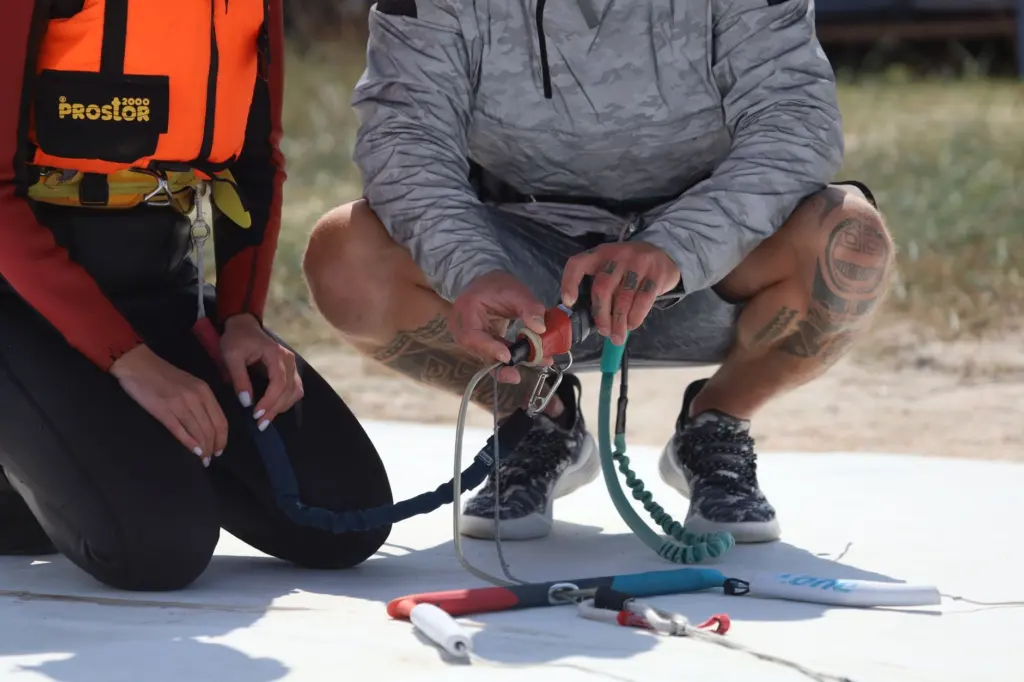
The practical rule is to read the label. If you want flotation, choose a product that states an approval for it, rather than assuming a padded vest will keep you up. If you want padding as well, look for a vest that explicitly offers both, or layer a padded vest under or over an approved flotation aid in a way that does not restrict your harness or movement.
Whichever you pick, put it on with the harness you will actually use. Bulk under the arms or around the waist can interfere with the harness, so test the combination on land before trusting it on the water.
Matching protection to the session
The more remote the session, the more your kit must work without outside help. Safety guidance is blunt on distance: never ride out beyond your swimming capabilities. That sets a ceiling on how far offshore you should go in the first place, and it is not something gear can override.
Where rescue would be slow, a crash that stuns you becomes far more serious. A helmet that stays on and drains, plus an approved flotation aid, covers the two failures that matter most: a blow to the head and difficulty staying afloat afterwards. Treat protective gear as most important on offshore days, at remote spots and at hard-shoreline launches. On a busy, soft-edged beach with other riders and help close by, the same kit is still sensible but the margin for error is wider.
| Situation | What to check | Planning use |
|---|---|---|
| Hard or rocky launch and landing | Helmet with shock-absorbing foam liner and secure chin strap; padded vest | Helmets are designed for impact injuries, so this is the clearest case for wearing one. |
| Repeated falls into water | Water-draining ear protection and ventilation | Prevents water from collecting inside the shell. |
| Remote or offshore session | Flotation-approved vest and a helmet that stays fixed | Guidance says to wear an approved PFD even as a good swimmer, and not to ride beyond your swimming capability. |
| Shared or multi-sport helmet | Ear protection that opens for drainage | A closed-ear helmet does not suit water use. |
The table draws on water-helmet feature descriptions and kitesurfing safety tips.
What helmets cost
Expect to spend in the mid-range for a purpose-built water helmet. A retailer’s helmet range lists the Mystic Vandal Pro at $143.99, the Gath Surf Convertible at $149.00 and the Oakley WTR Icon Surf Helmet at $175.00. The same listing gives $179.99 as the highest price in the range.
Those prices are a snapshot, not a rule, and the forum report above shows a cheaper wakeboard helmet can serve. Spend according to features: drainage, a secure strap and a stated liner matter more than a premium name. To see how a helmet fits into the whole kit budget, check our guide to kitesurfing equipment price.
Troubleshooting common problems
- Helmet shifts or lifts after a fall. Re-tighten the chin strap, and if it still moves, try a different size rather than overtightening.
- Water stays trapped around the ears. The ear openings are blocked or the design is not water-specific. A model with water-draining ear protection, or removable ear guards, solves it.
- Vest rides up under the harness. Try the combination on land and change vest or harness position until neither restricts the other.
- Vest feels protective but you are unsure about flotation. Look for a stated flotation approval on the label, as padding alone does not tell you.
- You are tempted to skip the helmet on a calm day. Hard shorelines and remote spots do not become safer because the water is flat, so keep it on there.
Frequently asked questions
| Question | Answer |
|---|---|
| How many sizes do helmets come in? | Retailer listings show 3 sizes for the Mystic Vandal Pro and the Oakley WTR Icon, and 4 sizes for the Gath Surf Convertible, so match the size to your head before adjusting the strap. |
| What should I do before riding somewhere remote? | Tell someone where you are going and when you expect to return, as kitesurfing safety guidance advises. |
| Does a wetsuit count as protective gear? | Yes. Safety guidance recommends a wetsuit to protect against hypothermia. Our kitesurfing wetsuit guide covers choosing one. |
| What is the top price in a typical helmet range? | One retailer’s kiteboarding helmet range tops out at $179.99. |