Quick answer: kitesurfing squall safety starts on the beach: launch only in stable wind with a forecast of cloud cover and no showers, and stay ashore when dark cloud, rain or thunder is approaching.
Squalls and storms matter most when you ride ocean waves, where there is little room to recover from a surprise. The wider context sits in this guide on how to kitesurf in waves. This page covers only the go/no-go call.
Go or no-go: the decision criteria
The safest squall decision is made before the kite leaves the bag. Kitesurf Belgium’s guidance on when to kitesurf tells riders to choose a stable wind and a favourable forecast, meaning cloud cover and no showers. Anything outside that description starts the session at no-go or, at best, at “wait and watch”.
The table turns the guidance into decisions you can apply on the beach.
| Signal | Decision | Planning use |
|---|---|---|
| Stable wind, forecast of cloud cover and no showers | Launch is reasonable | Treat this as the baseline for starting, not a guarantee for the whole session. Keep checking the sky. |
| Showers in the forecast | Stay ashore | Showers fall outside the favourable forecast described above, so a session built around them starts from a no-go. |
| Sunset approaching | Be out of the water before sunset | Plan the last landing early so fading light never forces a late, rushed return. |
| Air temperature below 5°C without suitable equipment | Stay ashore | Apply this winter limit alongside the squall check, because cold and weather problems compound each other. |
| No partner on the beach | Do not go alone | A squall is when a rider most needs someone watching from shore. |
These limits come from Kitesurf Belgium’s guidance on when to kitesurf.
Three rules follow from the table:
- Forecast problem means no launch. If showers are forecast, do not hope they miss the spot. The favourable forecast already excludes them.
- Doubt means wait. A kite can be launched later, but it cannot be recovered from a bad decision made on the water.
- The checks stack. A clean forecast does not cancel a darkening sky, and a calm sky does not cancel a failed forecast check.
How to spot a squall before it reaches you
You spot a squall by combining the forecast, the sky and the water surface, then reading all three again every few minutes. No single clue is enough. A forecast with cloud cover and no showers is the starting point, so any rain that appears is already a departure from the plan.
Start with the forecast and radar
Read the forecast for the full length of the planned session, not just the launch hour. Look for wind that is described as steady and for any mention of showers. Before launching, also open a rain radar loop from your national weather service or meteorological agency. If rain cells are tracking toward your spot, treat the session as cancelled rather than shortened.
Read the sky and the water
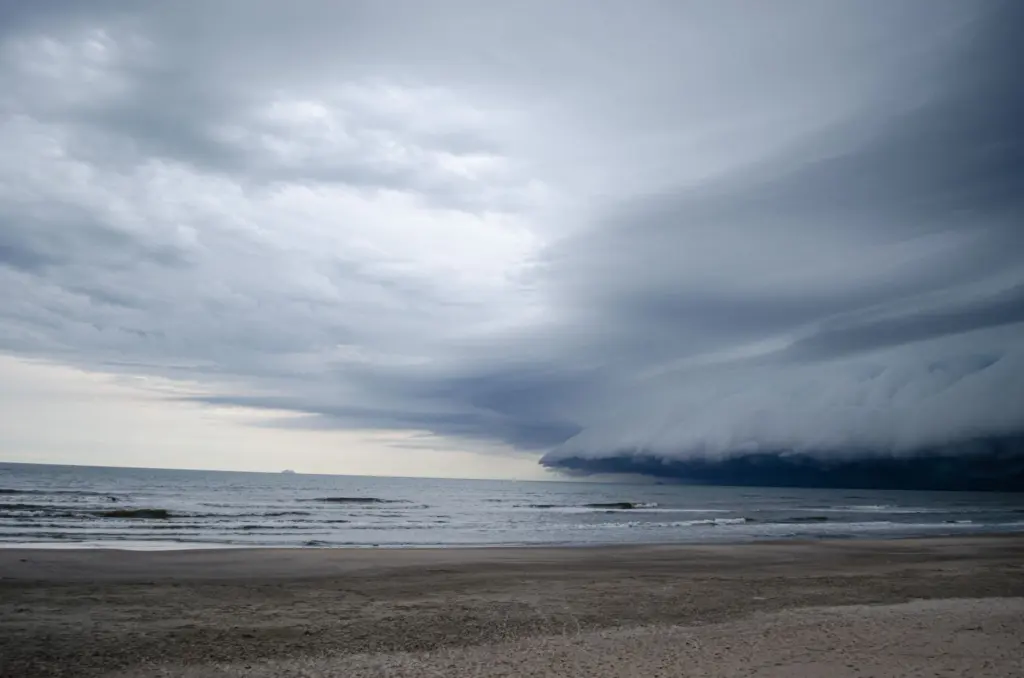
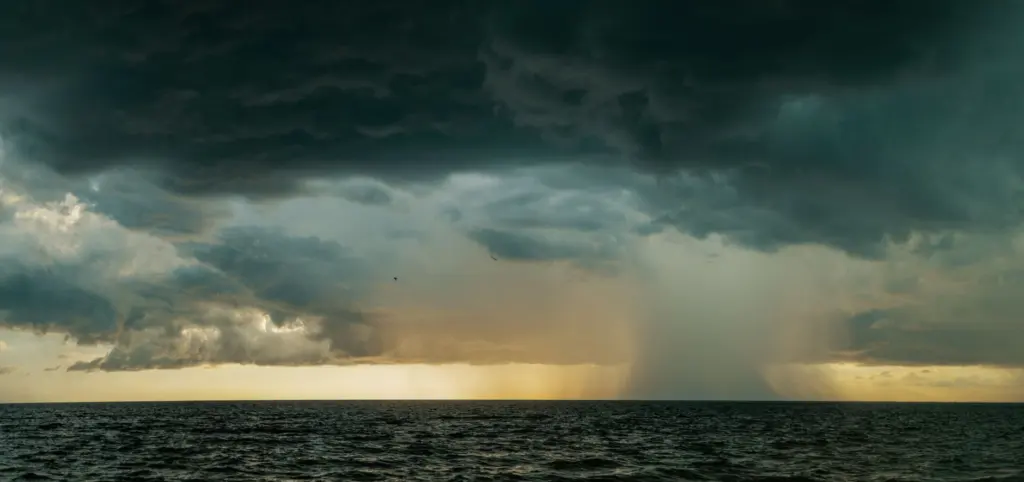
Look to windward, because that is where weather arrives from. A low, dark cloud bank spreading across the horizon is a reason to stop rigging. In the photo below, a grey curtain of rain hangs beneath a dark cloud layer while a lighter band of sky sits along the horizon. That contrast, a bright strip beside a dark rain-bearing mass, is the kind of scene that should send you up the beach, not down to the water.
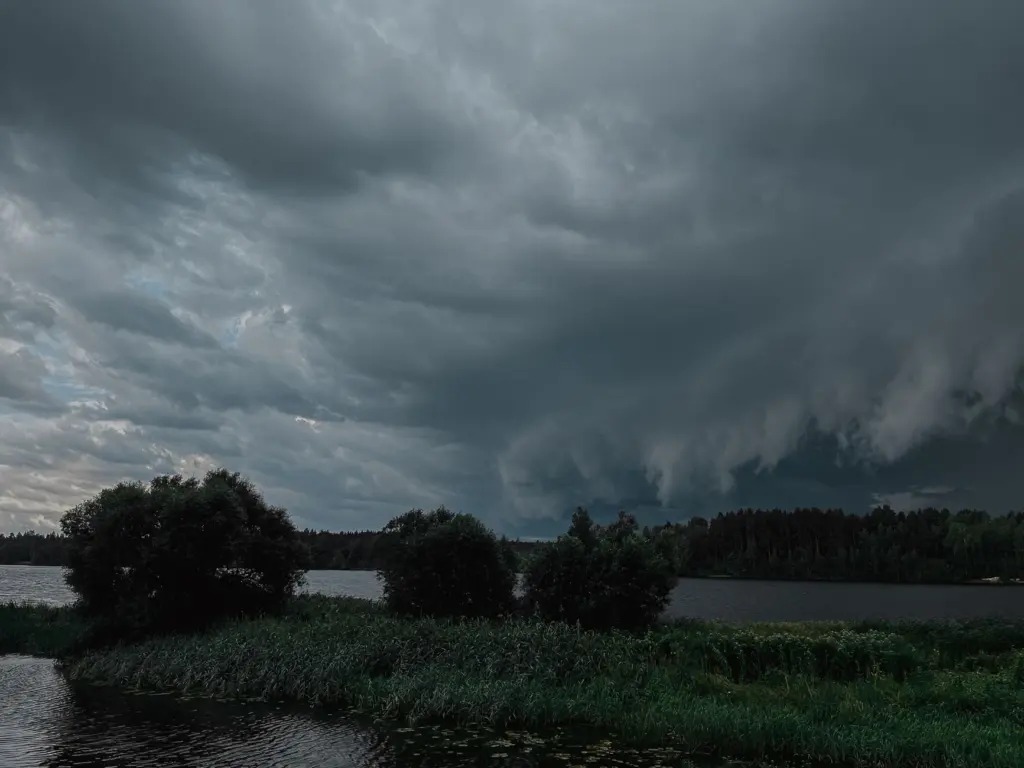
Shape matters too. A cloud mass with a dark, raised leading edge that is moving toward you is a stronger warning than scattered clouds that drift by. The second photo shows dark cloud masses stacked over a lake. It is an illustration of that look, not of a specific kitesurfing spot.
Watch from the beach, not the water
Anyone ashore can stand back and scan the whole horizon, which a rider focused on the next wave cannot do. That is one practical reason to ride with a partner: one person watching the weather while the other rides. The same guidance that favours stable wind and a clean forecast also advises against sailing alone.
Kitesurfing max wind speed and gusts
There is no single maximum wind speed that suits every rider, so the useful question is how far a squall can push conditions beyond what your kite and skill can handle. The kite maker’s wind range chart for your specific kite, combined with your own weight and ability, sets your personal ceiling. A ceiling is not a target. A rider who is comfortable at the top of a kite’s range in steady wind has no margin left when a squall arrives.
Steadiness counts for more than the headline number. Kitesurf Belgium’s advice to choose a stable wind reflects this: a wind that holds one strength is easier to manage than a wind that swings between lulls and surges. Squalls tend to be the opposite of that, which is why showers and dark cloud are no-go signs even when the number on the beach looks acceptable.
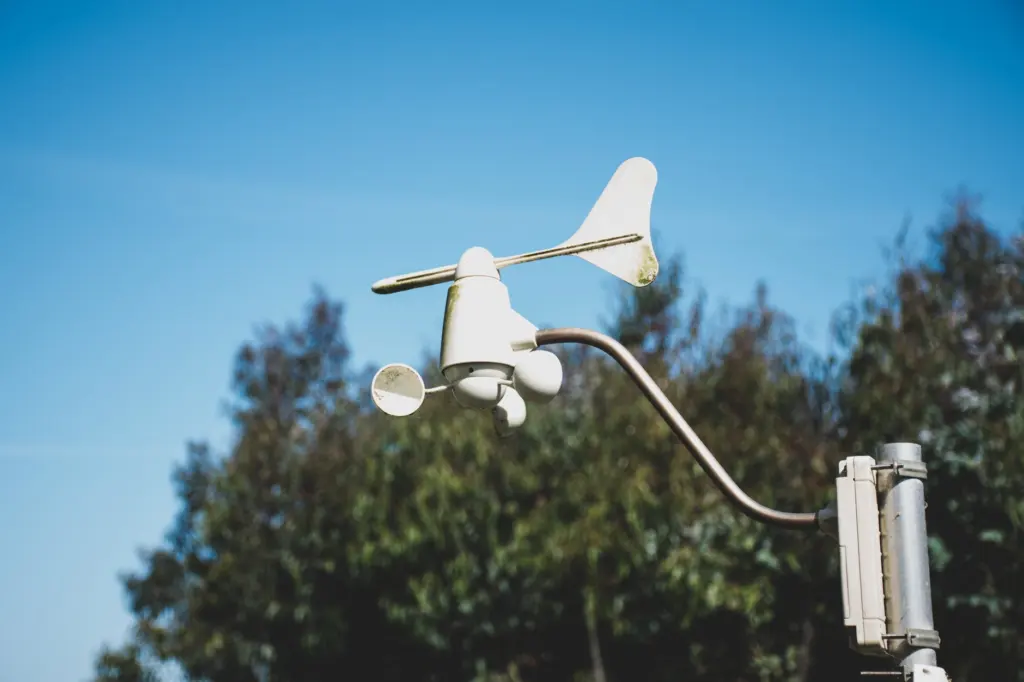
Use a handheld or fixed anemometer to compare readings over several minutes. If the readings keep jumping, the wind is not stable, and the stable-wind condition is not met. Sudden gusts are also the situation in which helmets are said to help. New Wave Kiteboarding’s land safety guidance notes that helmets can prevent head injuries during sudden gusts or falls. A helmet is protection for a bad moment, not a reason to accept one.
Thunderstorm safety: lightning means ashore
Kitesurfing thunderstorm safety has one rule that overrides all others: if there is lightning or thunder in the area, nobody should be on the water or rigging a kite. The decision does not depend on wind strength, how good the waves look or how much of the session remains.
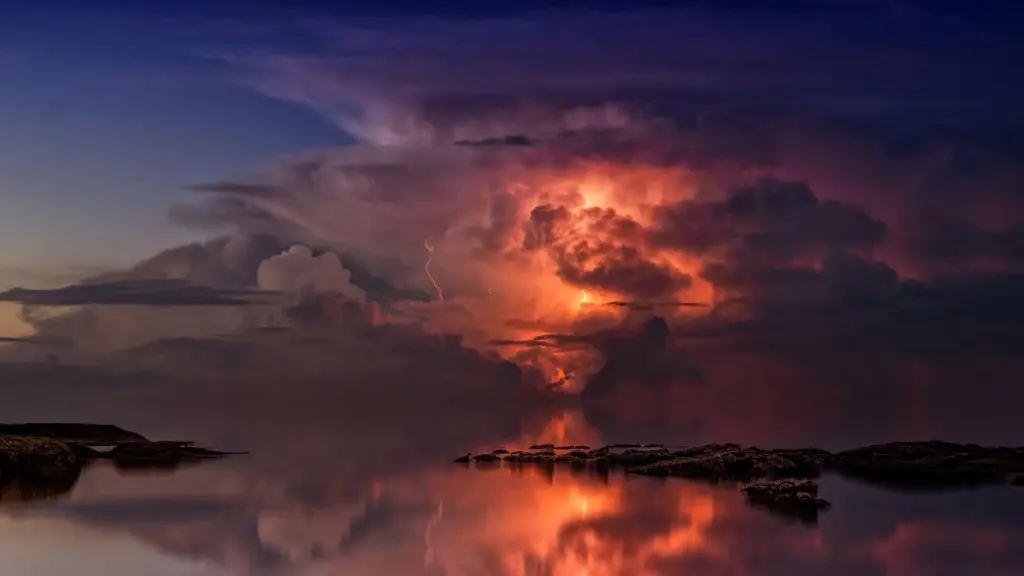
Dusk adds a second pressure. The guidance on when to kitesurf says to get out of the water before sunset, so a storm arriving late in the day leaves less margin for error than the same storm at midday. If thunderstorms are possible, bring the session forward or cancel it.
Distance is a poor reason to keep riding. A storm that looks far away on the horizon can still be moving toward the beach, so check the radar and land the kite while there is still time to pack away calmly.
Coming ashore and staying ashore
When the signs say stop, a controlled landing matters as much as the decision itself. New Wave Kiteboarding advises landing in a clear area, away from water and other obstructions. It also says the launch area should be spacious and free from obstructions such as trees, power lines and crowds. A beach that fits that description on a calm morning can fill up quickly when everyone lands at once, so choose the landing spot with that in mind.
- Use a buddy. The same safety guidance says to always have a buddy assist with your launch, and the same person can help catch the kite on landing.
- Leave room at the water’s edge. A cleared strip of beach gives you space to land and to walk the kite away from the waterline.
- Know the spot’s hazards. Hazards such as reefs and rocks make a panicked exit more dangerous, as covered in the guide to kitesurfing over reef safety.
- Plan the exit. Where waves break on the shore, the guide on how to kitesurf through shore break explains why coming in early beats coming in rushed.
Troubleshooting common squall situations
The forecast was clean but the sky is changing
Trust the sky over the forecast. The favourable forecast was a condition for launching, and a new dark cloud bank or rain means that condition no longer holds. Come in and wait.
Other riders are still out
Their decision does not change yours. Riders vary in skill and kit, and a rider who stays out may simply be taking a risk. Land your own kite and let the conditions, not the crowd, set the call.
The squall has passed but the sky is still dark
Wait. Because a forecast with showers does not meet the favourable description, relaunch only after the rain has cleared and the wind has settled to something steady again. If sunset is close, the session is over, since the guidance is to be off the water before sunset.
It is cold as well as unsettled
Cold raises the cost of every delay. The winter guidance says not to sail below 5°C without suitable equipment, so on a cold day with an uncertain sky the better decision is usually to skip the session.
Frequently asked questions
Is there one maximum wind speed for kitesurfing?
No single figure suits every rider. Your kite’s wind range chart and your own weight and skill set your ceiling, and a stable wind is safer than a strong one that keeps changing.
Can I keep riding if thunder sounds distant?
No. Thunder or lightning in the area is a reason to be ashore, and a storm that looks far away can still be heading for the beach. Land the kite and check the radar.
Is it safe to kitesurf alone if the forecast is clear?
The guidance on when to kitesurf says not to go sailing alone. A partner on the beach can watch the sky and help with launching and landing, as the buddy advice suggests.
Does a helmet make riding into a squall acceptable?
No. Helmets can prevent head injuries during sudden gusts or falls, but they are protection for a bad moment. They do not turn a squall into acceptable conditions.